

Located on the east side of 16th Street, NW, north of the former Meridian Hill Hotel for Women, is the Warder Mansion Apartments. The Warder Mansion, previously located at 1515 K Street, NW, was formerly the home of Benjamin Head Warder (1824-1894) and his wife, Ellen Nancy Ormsbee Warder (1840-1928). Benjamin Warder, a Chicago businessman, founded and served as president of Chicago-based farm machinery manufacturer, Warder, Bushness & Glessner Company (which merged into International Harvester in 1908).

Upon his retirement from WB & G Co., Benjamin Warder and his family moved to Washington, DC, and began real estate investing and community development. In June 1886, Warder purchased a 42-acre estate for subdivision. These subdivided lots would eventually become known as the Park View neighborhood in northwest DC.
Among Warder’s many real estate purchases were several lots on K Street, NW, between 15th and 16th Streets, NW. These lots, purchased in 1885 for an estimated $44,000 ($1.4M in 2024), would become the site of their Washington, DC home, 1515 K Street, NW. The Warders commissioned Henry Hobson Richardson (1838-1886) to design their home for approximately $150,000 ($5M today). Richardson, along with Louis Sullivan and Frank Lloyd Wright, is known as one of “the recognized trinity of American architecture.” Richardson’s late Victorian-style referred to as “Richardsonian Romanesque” was considered the first uniquely American architectural style.
With permits in hand, construction of the Warder Mansion began in March 1886. Tragically, one month later, on April 26, 1886, Richardson succumbed to Bright’s disease (nephritis). The construction project, which would take place over the next year and a half, was completed by his assistant architects, George F. Shepley (1860–1903), Charles H. Rutan (1851–1914), and Charles A. Coolidge (1858–1936).
On October 27, 1887, the Evening Star newspaper reported that the Warder’s “exquisite white grotto house postulates white cross knights, aesthetic maidens wearing white rosebuds and medieval gowns.” The Warders took possession of their new home in December 1887, which is said to be the first private home in Washington, DC, to have modern plumbing.
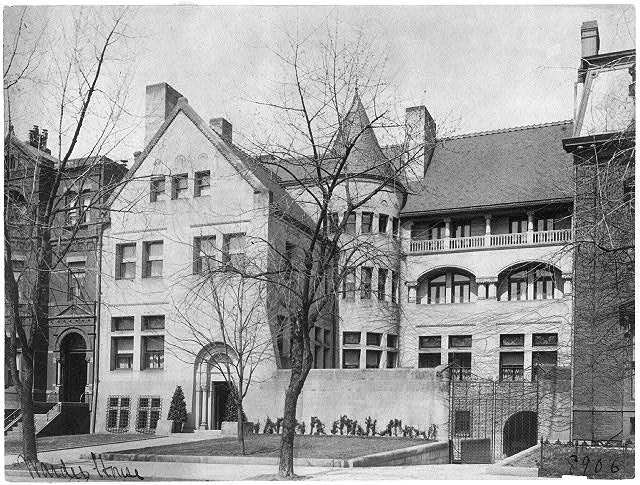
Public domain photograph from the Frances Benjamin Johnston Collection of the Library of Congress’s Prints and Photographs Division under digital ID cph.3b04657.
Over the next six years, the Warder Mansion was the site of benefits, dances, weddings, and high-society balls. On February 7, 1893, the Warders hosted a newsworthy cotillion attended by members of congress, judges, and clergy. An invitation to the Warder ball was highly coveted. In fact, Countess Marguerite Cassini (1882-1961), mother of the famed designer Oleg Cassini (1913-2006), said after not receiving an invitation to the Warder annual ball, that the night of the ball was “the longest I ever cried.”
Unfortunately, Benjamin Warder had little time to enjoy his spectacular home, as he died in Cairo, Egypt, on January 13, 1894. After his death, Ellen Warder remained secluded until late 1895, after which she resumed her travels, entertaining and philanthropy. In 1915, Ellen Warder took up residence in an elegant apartment building at 1155 16th Street, NW. While sometimes closed for extended periods, the mansion on K Street was still occasionally used for entertaining, occupied by Warder family members, leased, or used as temporary lodging for visiting dignitaries, such as Dr. Epitacio Pessoa, the president-elect of Brazil, who in turn hosted President and Mrs. Woodrow Wilson at the mansion. Ellen Warder, who died in 1928, quietly sold the K Street property to Frank B. Essex, a Washington, DC builder, in April 1921.


On January 16, 1923, the Evening Star newspaper reported plans to demolish the Warder Mansion to make way for a new 11-story “high-rise” office building called the Investment Building (located at 1501 K Street, NW). The fate of the Richardsonian building was seemingly “set in stone” until architect George Oakley Totten, Jr. (1886-1939), upon hearing of the impending demolition of the Richardson-designed home, purchased most of the mansion to rebuild on the west side of his home at 2633 16th Street, NW.

No known copyright restrictions.
Totten set to work dismantling Warder Mansion stone by stone. Each stone was numbered and put into temporary storage, along with many of the interior features of the house, some of which included red and white mahogany paneling, prized Numidian marble arches, hand-carved white holly paneling, and a quarter-sawn oak staircase.
On December 1, 1924, Totten began transferring the stored structure to his 16th Street property for reassembly into an apartment dwelling. However, the 31-ton marble entryway to the mansion had been donated to the Smithsonian National Museum of Natural History. Totten attempted to retrieve the gifted entryway from the museum, but was unsuccessful. Fortunately, Totten had made plaster casts of the original entryway so he was able to create a replica to complete the reconstruction of the house. (The original entryway was sold at auction in 2012 for $20,000 by Sloans and Kenyon, an auction house in Chevy Chase, Maryland.)


In December 1925, five apartments were advertised for rental. Three “de Luxe” apartments comprising either 12 or 15 rooms, and two small apartments. Each of the deluxe apartments occupied an entire floor. Totten’s intentions were to rent the large luxury apartments to politicians, diplomats and government dignitaries, pointing out in newspaper advertisements that the building’s location was in “the center of the diplomatic section.”
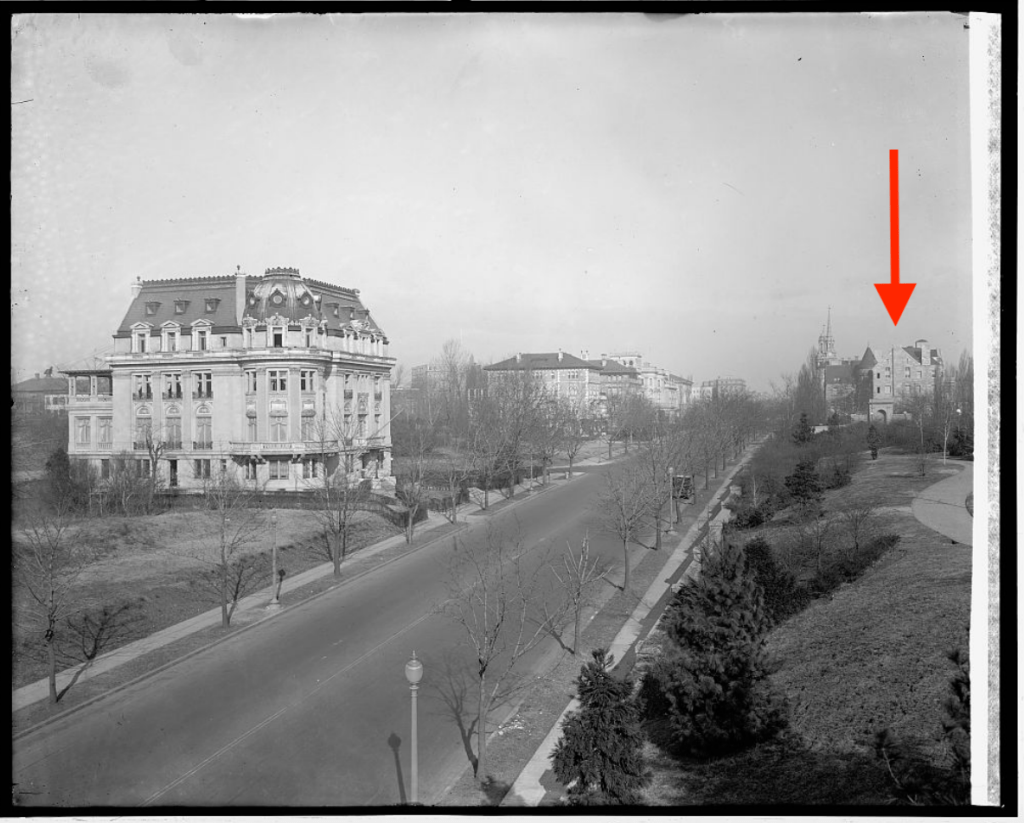


Evening Star, Sat, Jan 20, 1934 ·Page 22
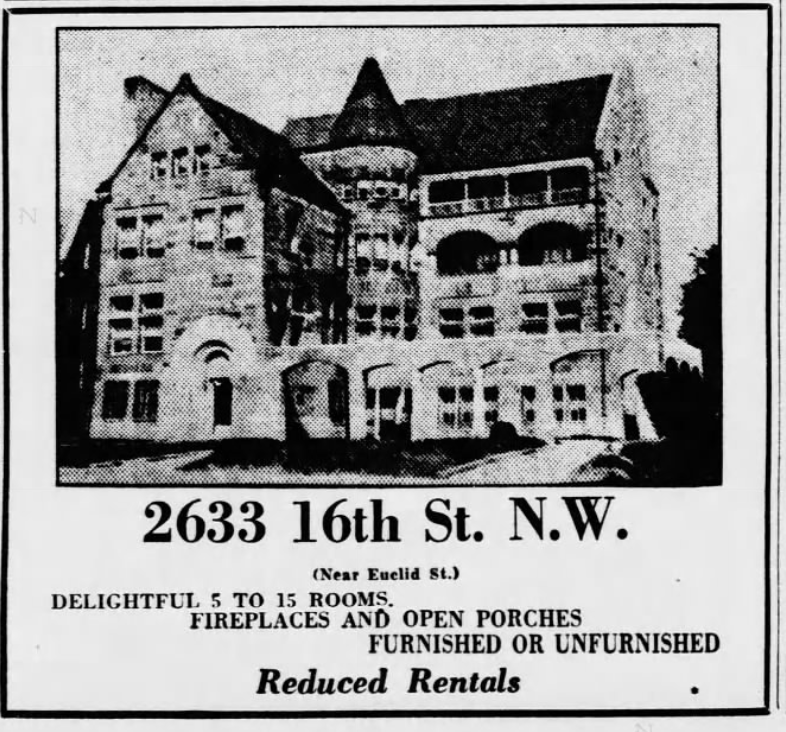
Unfortunately, as the Great Depression set in, renting luxury apartments proved difficult. Over the next several years, the apartments would be reconfigured to add additional smaller units for rent. This, however, did not alleviate Totten’s escalating financial difficulties. Between 1930 and 1938, Totten, having lost his architecture design practice, defaulted on the property loan several times, but it wasn’t until August 20, 1938, that the Warder Mansion Apartments, as well as Totten’s home at the rear of the mansion, reverted to the Fidelity Philadelphia Trust Company.
George Oakley Totten, Jr. died on February 1, 1939, after a short illness. His widow, Swedish artist, Hedvig Erika “Vicken” von Post Börjeson Totten (1886-1950) remained in the house until the end of 1940, after which she remarried on February 4, 1941.


Evening star, Sat, Jan 23, 1943 ·Page 12

Evening Star, Wed, Jul 31, 1946 ·Page 21
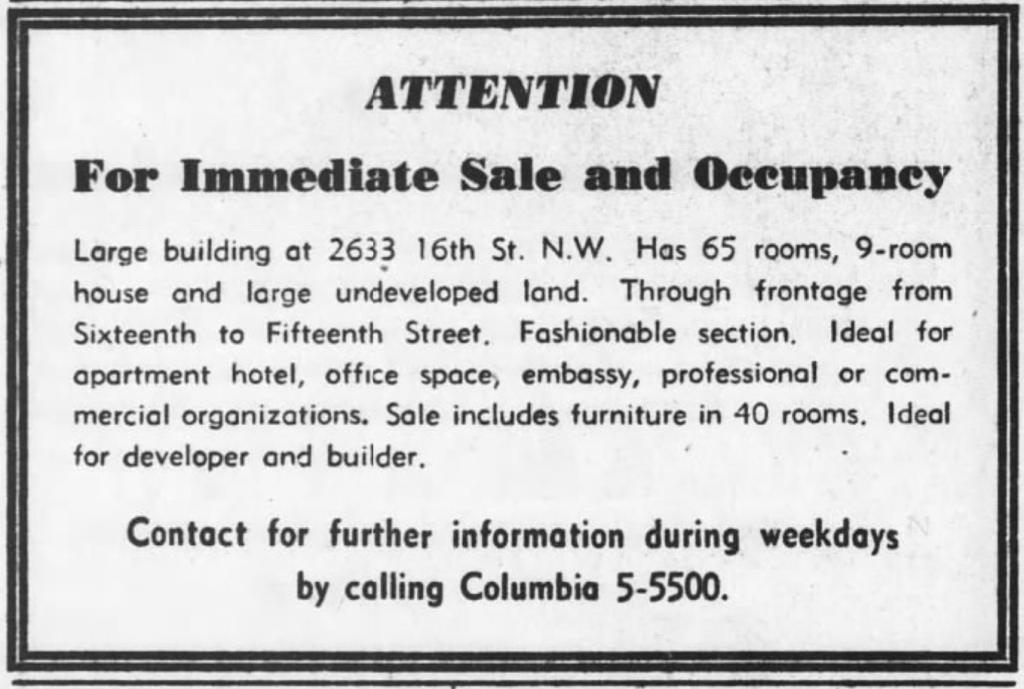

$240,000 ($2.8M today). Evening star, Sat, Aug 22, 1953 ·Page 11
After 20 years, the National Lutheran Council sold the property to the newly established Antioch School of Law. By the time the school took ownership of the buildings, the interior of the Warder Mansion building scarcely resembled the original layout, as many of the original architectural details had been altered, removed, or spoiled in some manner. Further renovations by the school to upgrade electrical systems, modernize heating and air conditioning systems, and improve the general layout for school use further altered the interior of the buildings.
The Antioch School of Law remained at the Warder Mansion through 1986, after which the buildings were bought by a local construction company. By 1995, the interior of the buildings fell victim to squatters, drug users, and arsonists who caused intentional damage to the walls, fireplaces, and remaining fine features. The District’s Board of Condemnation feared the only remedy was the demolition of the buildings. By 1998, the DC Preservation League listed the Warder Mansion as one of DC’s ten most endangered sites due to “demolition by neglect.” In 1999, the District began “cracking down” on negligent property owners, and by 2001, the Warder Mansion was removed from the endangered list, and the new owners began a year-long renovation project to return the buildings to use as rental apartments. In August 2002, the Warder Mansion luxury rentals renovation project, which comprised 38 apartments in the original building and 80 affordable-housing apartments in a newly-constructed building at the rear of the mansion, was complete.

Today, at the Warder Mansion Apartments, you will find twenty-five foot ceilings in some units, as well as fireplaces with ornate mantels and, of course, modern amenities. Careful renovation of the Warder Mansion Apartments made each apartment truly unique. Today, units in the main building rent for approximately $2,000 for a studio to $4,800 for a 2-bedroom apartment.
The Warder Mansion was added to the National Register of Historic Places on April 14, 1972, and is designated as a contributing structure of the Meridian Hill Historic District.

 AROUND TOWN